Eloine Chapman/Shutterstock
Every year, scientists learn more and more about the world around us. Now, a new study suggests that some mammals can start dreaming even before birth. That’s right! Read on to find out more…
Dreaming Before Birth

Andrii Orlov/Shutterstock
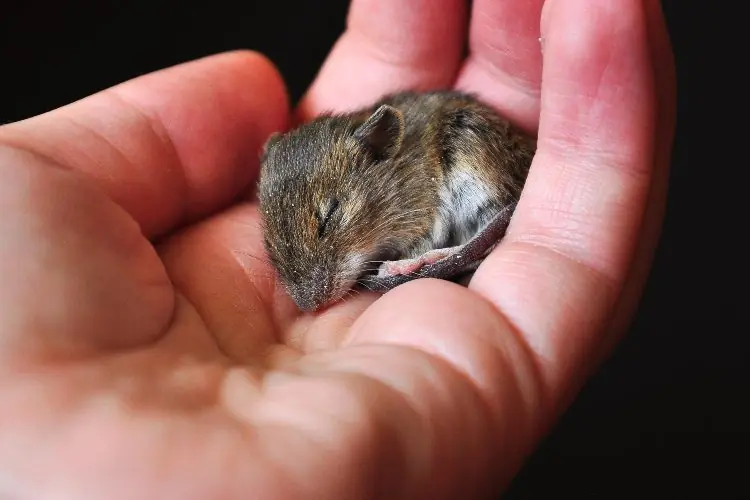
For many years, scientists have wondered why, when a newborn mammal sees the world for the first time, it doesn’t seem to need to develop its orientation or ability to track objects. Now, a new Yale study suggests an answer for this question: it might be because many mammals might actually dream before birth. That’s right! Michael Crair, the William Ziegler III Professor of Neuroscience and professor of ophthalmology and visual science at Yale, led the team. In the study, Crair and his team analyzed the activity that emanates from the neonatal retina in mice before their eyes ever open, which is later replaced by another, more mature network.
According to the team, the network of neural transmissions of visual stimuli to the brain stores information for after birth. “At eye opening, mammals are capable of pretty sophisticated behavior,” said Crair, senior author of the study, who is also vice provost for research at Yale. “But how do the circuits form that allow us to perceive motion and navigate the world? It turns out we are born capable of many of these behaviors, at least in rudimentary form.” Incredibly, it seems that dreaming before birth helps kick start evolution before the creature even enters the world!
Mammals’ Complicated Brain Structure
desvitlab/Shutterstock
During the study, the Yale team imaged the brains before and after birth. Before birth, the retinal waves have a similar pattern to those observed in children as they move through a real environment. “This early dream-like activity makes evolutionary sense because it allows a mouse to anticipate what it will experience after opening its eyes, and be prepared to respond immediately to environmental threats,” Crair explained. Crair and his team confirmed their theory by blocking the function of starburst amacrine cells. Without the aid of this “dreaming,” the mice could not function properly after birth.
So, what happens to the starburst amacrine cells in adult mice? Are they unnecessary for motion after birth? Not exactly. These cells are responsible for a mature motion detection circuit in adults, which helps grown-up mice function in their immediate environment.
Of course, as Crair himself says, mice are very different from humans. However, there is no doubt we are starting to understand better how babies understand objects and simple motions. “These brain circuits are self-organized at birth and some of the early teaching is already done,” Crair said. “It’s like dreaming about what you are going to see before you even open your eyes.”
Sources: Good News Network , National Geographic .