Bangkok Click Studio/Shutterstock
China once again rocked the world with a decision that many find over the line: all those under the age of 18 in the country, more than 268 million people, are now restricted to just three hours of video games a week. That’s right!
China Bans Video Games

Shift Drive/Shutterstock
As of last week, those under 18 in China can only play video games on the weekends and national holidays, between the hours of 8 p.m. and 9 p.m. on those days. To enforce this, access to games now requires “real-name verification and login systems.” The reason for this harsh rule? Well, according to China’s state media, seven in 10 Chinese minors play video games online for long hours. Just before this, the Chinese government proclaimed its frustration with online gaming by calling video games “electronic drugs” and “spiritual opium.”
“Teenagers are the future of our motherland,” a government spokesperson said. “Protecting the physical and mental health of minors is related to the people’s vital interests and relates to the cultivation of the younger generation in the era of national rejuvenation.”
As you might imagine, reactions to the new law have been mixed. Some parents think that the government has made the right choice, thinking children should spend more time studying or exercising, instead of playing video games. Meanwhile, others believe that the government has overstepped, entering their personal lives. “It seems to be part of a major push to really bring the government front and center into all elements of people’s lives,” online media expert Paul Haswell said to CBS News.
Others think that the new law will be impossible to enforce. “They will just use their parents’ logins, how can they control it?” one Weibo comment read. Other users pointed out that children could just use a virtual private network (VPN) to access non-Chinese gaming servers. Others still said that this is just one step in China’s desire to control the internet within its borders completely…
Joining Detox Boot Camps
Fernando Moleres/Mother Jones
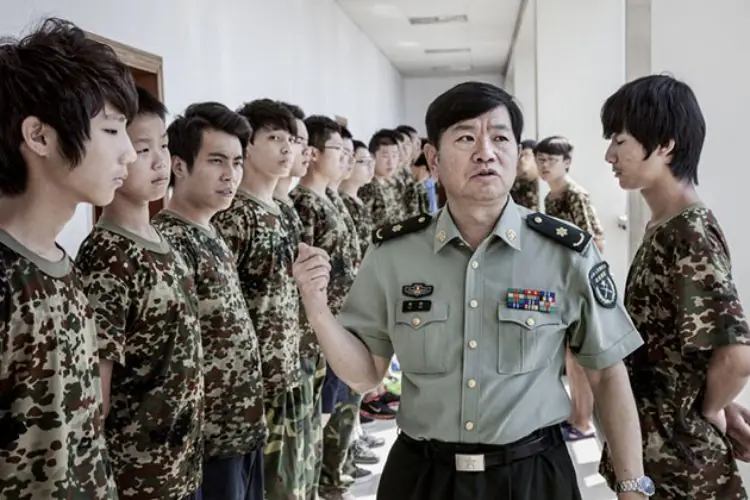
Of course, not everyone is against the ruling. “I’ve been advocating for this for years,” said Tao Ran, director of the Adolescent Psychological Development Base (seen above). “The Chinese government’s strong measure this time is the most successful attempt in our fight against addiction.” Ran’s camp, located 20 miles from Beijing, helps kids “detox” from video games.
The policy is just one part of China’s push to both control personal habits as well as combat the influence of non-Chinese media and technology. Not only has Beijing recently targeted many large firms in the tech sector, including Alibaba and Didi, two of the biggest companies in China. They had also started changing the rules for popular online tutoring companies. After all, these online spaces are places where it’s harder for the Chinese government to monitor communications, according to CBS News.
“Remember, online games are, by their very nature, social. And it’s another social space that would have to be regulated. Think of how much censorship is going on in terms of the internet in China,” said Haswell. “The online chat rooms related to a game might be harder to moderate.”
It’s an interesting theory, let’s watch how things turn out…